FAQ Search Results
I have concerns about a nurse but am unsure about whether to raise an official complaint. Who do I contact in the first instance?
If you are a patient, the relative of a patient or another person supporting a patient, you should raise your concerns at a local level first. Contact the ward, hospital or clinic management to find out how they deal with concerns and complaints.
If you feel it is necessary to take further action, you can contact the Fitness to Practise Department at the Nursing and Midwifery Board of Ireland (NMBI).
You can find out more about making a complaint and the complaints process on these pages:
Other organisations and agencies may be able to help you by providing support or advocacy. Go to our Who can help page.
If you are an employer you can find out more about making a complaint on the Complaints from employers page.
If you are a nurse or midwife you can find out more about making a complaint on the Complaints from nurses and midwives page.
Do I have to give my name when making a complaint about a nurse or midwife?
Anonymous complaints cannot be considered unless further enquiries provide information that causes concern about a nurse or midwife’s conduct and their ability to practise safely. NMBI takes any complaint about a nurse or midwife seriously.
The more information that is provided in relation to a complaint (including the names of any witnesses or persons raising a concern), the more efficiently that complaint can be investigated.
I have concerns about a particular nurse but I am not sure how NMBI assesses the complaints it receives. What should I do?
People make complaints about nurses and midwives for different reasons. There are several grounds for complaints set out in the Nurses and Midwives Act 2011.
You should report a nurse or midwife if you know or suspect their behaviour:
- Has harmed or may harm you, a patient or someone else
- Has been so unprofessional that unless the Board of NMBI takes action, the general public will lose trust in the nursing and/or midwifery professions.
If you are a registered nurse or a registered midwife you have a professional responsibility to report any safety concerns you have about the healthcare environment. This responsibility extends to reporting your concerns where you consider patients’ dignity is not being respected.
Signs that you should be alert to are listed on the Complaints from employers page and Complaints from nurses and midwives pages.
How long does the complaints process take?
NMBI is aware that the complaints process can be a stressful and worrying time for anyone involved, including the person who has made a complaint, potential witnesses and the nurse or midwife herself.
Under the Nurses and Midwives Act 2011, the Preliminary Proceedings Committee (PPC) is required to make reasonable efforts to ensure that complaints are processed in a timely manner. The amount of time it takes to process a complaint can vary, depending on how complex the complaint is.
In some cases another body or authority such as An Garda Síochána may have to complete its investigation before the PPC can begin its own investigation.
If a complaint is referred to the Fitness to Practise Committee for an inquiry, it can take another 18-24 months to hold the inquiry, but this again can vary, depending on how complex the complaint is.
You can find out more about the complaints process on this page.
What can the NMBI do about a complaint?
Once we have investigated your complaint there are several courses of action that can be taken. These include referring the complaint to another body, offering mediation between yourself and the nurse or midwife or imposing one or more sanction on the nurse or midwife.
NMBI cannot award compensation to you.
For more information on the possible outcomes of an investigation of a complaint, please go to page:
How complaints are dealt with
I am a registered midwife. I’m aware that a complaint has been made about me. Can I remove my name from the Register of Nurses and Midwives?
A registered nurse or registered midwife may apply to the Board of NMBI to have his or her registration removed from the Register or from a division of the Register. However, if you are the subject of a complaint that has not been dealt with under the relevant parts of the Nurses and Midwives Act 2011, the Board will not consider your application until this process is complete.
If a complaint has been made about me, can I continue to work or practise as a nurse or midwife?
You can continue to work or practise as a nurse or midwife while there are no restrictions on your registration.
In some circumstances the Board may apply to the High Court to suspend a nurse or midwife’s registration temporarily. The Board may do this even in situations where no complaint has been made but where suspension of the nurse or midwife’s registration is considered necessary to protect the public.
When considering any complaint the NMBI’s Preliminary Proceedings Committee (PPC) will always assess whether or not the nurse or midwife’s registration should be suspended. If the PPC considers that the nurse or midwife’s registration should be suspended, it will pass the matter on to the Board.
If the complaint is referred for an inquiry, you may still continue to work or practise.
What happens at an inquiry?
The inquiry is similar to a hearing before a Court or Tribunal. The Fitness to Practise Committee (FtPC) will hear the evidence presented at the inquiry. First the FtPC will hear from by the legal representatives acting for the CEO of the NMBI. These legal representatives will open the inquiry, present evidence and call witness to give evidence in support of the complaint.
The nurse or midwife or her representative may question these witnesses about their evidence. The FtPC may also question these witnesses. Then the nurse or midwife or her representative may make submissions to the FtPC and call witnesses to give evidence. The nurse or midwife’s witnesses may be cross-examined by the CEO’s legal representative and by the FtPC.
There can be long periods of waiting at inquiries. If you are called to give evidence, it is suggested that you bring reading materials or a laptop. Free Wifi is available at the NMBI premises.
Inquiries are usually held in public. Depending on the individual circumstances of each inquiry, the whole inquiry or parts of the inquiry may be held in private.
For more information about what happens at inquiries, go the Inquiries page.
I made a complaint but now I wish to withdraw it. What should I do?
You should notify NMBI that you wish to withdraw your complaint. If you withdraw your complaint while it is being considered by the Preliminary Proceedings Committee (PPC), the PPC may either decide to take no further action or may continue to deal with the complaint.
If you with draw your complaint while it is being considered by the Fitness to Practise Committee (FtPC), the FtPC may either decide to take no further action or may continue to deal with the complaint.
The Board must agree with the committee’s decision in any case.
I have received a subpoena to attend an inquiry as a witness but I will be on holiday. What can I do?
A subpoena or witness summons served in advance of the inquiry legally requires you to attend the inquiry to give evidence. However, in circumstances such as being on holiday, you should notify the Fitness to Practise Department or the CEO’s solicitors as soon as possible. You may be asked to produce evidence that you will be out of the country.
I’ve changed my address. How can I update my contact details with NMBI?
You can do this yourself by logging on to the site and updating your contact details. If you haven’t got an account already, you need to set up an online account with us. Visit the MyNMBI page to learn about setting up an account for the first time.
What happens to my details on the Register of Nurses and Midwives if my surname changes, because of marriage or civil partnership or because I’ve changed it by deed poll?
If you would like us to record your change of surname, you must send us a certified copy of your marriage certificate or civil partnership certificate. Please indicate, in a covering letter, whether you want to change your surname following marriage or civil partnership.
You should also indicate, in a covering letter, whether you would like us to use a double barrelled surname. We cannot use your church marriage certificate to change your name.
If you have officially changed your name since birth (other than a change of surname by marriage or civil partnership), you need to send us a certified copy of your legal change of name by Deed Poll.
Learn more about certified copies.
How do I change my name on the Register to the full Irish version of my name?
You need to provide NMBI with proof that you use this version of your name. You can do so by sending us a certified copy of your name in Irish on your passport, driving licence or on a utility bill.
We will not do a partial name change to Irish. For example, if your name in English is "Mary Ann Kelly" we will translate your name in full to "Máire Áine Uí Cheallaigh", but not "Mary Ann Uí Cheallaigh".
Learn more about certified copies.
My late mother was a nurse and a letter marked for her attention has been received from the Nursing and Midwifery Board of Ireland. How can I ensure that her name is removed from your database?
NMBI apologies to you and your family for any distress caused by the receipt of this letter. To ensure that your late mother’s name is removed from the Register of Nurses and Midwives, it would be appreciated if you would send an email to Registration@NMBI.ie or send a letter to the Registration Department, Nursing and Midwifery Board of Ireland, 18/20 Carysfort Avenue, Blackrock, County Dublin.
In your letter or email, please include the full name and PIN or date of birth of your late mother so that we may make the necessary change to the Register. Please also provide your contact details in case we need to make further contact with you.
I have a common name and share it with many other nurses on the Register. How do I ensure that I am not confused with someone else with the same name on the Register?
Your record that is publicly available on the Register of Nurses and Midwives includes names as per your birth certificate. While it is common for people to share first names and surnames it is rare to share a birth name, second name and surname. There are also details on your public record (such as when you joined the Register) that are unique to you.
Everyone on the Register has a PIN. This is a unique number for each individual on the Register
I am reviewing some of the entries on the Register of Nurses and Midwives. The status of some is shown as “inactive”. What does that mean?
Individuals on the Register who are inactive are nurses or midwives who for a number of reasons are no longer practising. They have not paid the Annual Retention Fee, one of the conditions which is necessary to maintain active registration and to practise as a nurse or midwife in Ireland under the Nurses and Midwives Act 2011.
I am planning to go abroad to work. What happens with my registration and what do I need from NMBI to ensure I can work abroad?
You can decide whether to maintain your registration when you are abroad and the decision you make will depend on your circumstances and your plans over the coming years. If you plan to work in another country, you will have to go through that country’s overseas registration process by that country’s relevant authority.
You will be asked for a Verification (CCPS) from NMBI and we will share certain registration information with that competent authority. For more details visit our Working outside Ireland page.
To apply for a Verification (CCPS), you need to complete the Verification (CCPS) Form, which is available when you log in through MyNMBI
My name has been removed from the Register for non-payment of the Annual Renewal. What is the process for restoring my name?
You need to complete the Restoration Form which is available by logging on to the website through MyNMBI. You need also to pay the Restoration to the Register Fee which is set out on our Fees page and pay the outstanding Annual Renewal. NMBI’s Registration Department will then process your application and will notify you when your name has been restored to the Register.
How can I join the Advanced Practise division of the Register?
For registration in the Advanced Nurse Practitioners division of the Register, certain criteria about the existing registration status, educational qualifications and experience must be met. It is necessary, for example, to be educated to Master’s degree level or higher and have a minimum of seven years post-registration details. Full details are available on our Registering as an ANP/AMP page.
I am a Registered General Nurse (RGN). My employer would like me to be deployed to the Children’s Ward in the hospital on an interim basis. However I have concerns about this because I am not a Registered Children’s Nurse. What is NMBI’s advice?
NMBI as the regulator does not control how staff are deployed or utilised in health care settings.
The quality of practice section of our Code of Professional Conduct and Ethics for Registered Nurses and Registered Midwives and the competence section of the Scope of Nursing and Midwifery Practice Framework aim to support and provide best practice for all nurses and midwives which will ensure protection of the public.
If you are being asked to provide nursing care in a different practice environment, you should review the key considerations section in the Scope Framework.
How do I register as a Nurse Prescriber?
Only those who have successfully completed an education programme for prescriptive authority approved by NMBI and are currently employed may apply for registration in the Nurse Prescribers Division.
To register with NMBI on the Nurse Prescribers Division of the Register of Nurses and Midwives, you must complete and submit an application form for this division. You are also required to have an approved Collaborative Practice Agreement (CPA) on file with your health service employer. You need to log into the site to access the Prescribing/CPA forms through MyNMBI.
How do I apply for admission to an education programme leading to prescriptive authority for nurses and midwives?
The following Higher Education Institutions (HEIs) been approved by NMBI to provide the education programme for prescriptive authority:
• The Royal College of Surgeons in Ireland,
• University College Cork,
• University College of Dublin
• University of Limerick
• National University of Ireland – Galway
• Dublin City University
• Trinity College
For further information on the course details you should visit the HEIs for more details of these programmes.
What is the usual timeframe for NMBI to process my application for the Nurse Prescribers Division of the Register for registration?
Following successful completion of the education programme in an NMBI-approved education programme, the individual nurse or midwife seeking to be registered as a nurse prescriber must submit the following:
The applicant must also have an approved Collective Practice Agreement (CPA) on file with his/her employer as a requirement for registration.
Confirmation of registration is typically given by NMBI within 10 working days. Notice will also be sent to the Director of Nursing/Midwifery or authorised individual of the health service employer.
How often do I need to renew my registration as a nurse prescriber and my Collaborative Practice Agreement (CPA)?
To maintain your registration with NMBI as a nurse prescriber you must pay your Annual Retention Fee (ARF). Failure to pay the ARF will result in your name being erased from the Register of Nurses under the Nurses and Midwives Act 2011.
You will be in breach of NMBI regulatory framework for prescriptive authority if you prescribe medicines without having a valid CPA. Changes to your CPA are managed locally at Health Service Provider level; however you must notify NMBI if you:
Please log into MyNMBI to access the CPA termination and recommencement forms.
I am a postgraduate student in an education programme which leads to prescriptive authority. Is it necessary for me to register as a student for NMBI's Candidate Register?
Yes, you must submit the Application Form (Post Graduate Candidate Register Form) for entry in the Candidate Register - Post-Graduate no later than 30 days after starting the prescribing education programme. This needs to be done in conjunction with your Higher Education Institution. If you have a change of name or address during the programme you must inform NMBI of this.
The form is available by logging on to MyNMBI.
Can my employer or anyone else such as a community pharmacist check the Register to check if my registration is active and my CPA is valid?
Yes. Anyone can check the Register of Nurses and Midwives. If your name is listed on the Nurse Prescribers Division of the Register an additional section will state the status of your CPA, whether it is valid or invalid.
What other bodies apart from NMBI should I refer to in relation to the use of abbreviations.
The HSE has published guidance in drawing up an approved list of abbreviations. This is included in a document Code of Practice for Healthcare Records Management document.
Internationally there is much guidance on the use of abbreviations within healthcare settings. The Institute for Safe Medication Practices (ISMP) compiled a list of more than 60 commonly used abbreviations, symbols, and dose designations that have been implicated in medication errors. The Joint Commission on Accreditation of Healthcare Organisations (JCAHO) is another useful resource.
ICAHO has conducted research finding the use of abbreviations in health care may be efficient, however this may be at the expense of patient safety by contributing to medication errors. In addition to publishing a list of approved abbreviations the JCAHO has published lists of approved and prohibited abbreviations.
What is NMBI’s role in setting pay and conditions for Irish nurses and midwives?
NMBI has no role in this. We are the regulatory body and our work is determined by the Nurses and Midwives Act 2011. Pay and conditions are set by health service employers in consultation with employees and their representatives.
Why was the organisation’s name changed from An Bord Altranais to NMBI?
This happened as a result of Nurses and Midwives Act 2011. It provided for the name to change to Bord Altranais agus Cnáimhseachais na hÉireann/ Nursing and Midwifery Board of Ireland and recognised midwifery as a separate profession.
What is NMBI’s role and functions?
The Nursing and Midwifery Board of Ireland (NMBI) is the regulatory body for nurses and midwives in Ireland. Its main role is to protect the public by making sure high standards are maintained in education, training, and professional practice.
NMBI sets the standards for:
- Education and training
- Registration
- Professional conduct and behaviour
It also provides guidance to support nurses and midwives in delivering safe and effective care.
NMBI maintains the Register of Nurses and Midwives and sets the requirements for registration. It approves and monitors education programmes to ensure they meet required standards.
NMBI publishes the Code of Professional Conduct and Ethics (2025) and other guidance to help nurses and midwives understand what is expected of them and maintain their competence.
If concerns are raised about a nurse or midwife, NMBI investigates through its fitness to practise processes and takes action if standards are not met.
Through all of its work, NMBI ensures that nurses and midwives practise safely, competently, and ethically in the public interest.
You will find more details of the Board of NMBI, board committees and the functions of individual departments in our What we Do section.
Does NMBI have a customer service charter?
I am a nurse who has qualified in the UK. What do I need to do to get my Irish registration; I am registered with the NMC?
Please visit our Qualified Outside Ireland page to read our information and guidelines for nurses who trained outside Ireland.
If I can’t remember my password, what should I do?
If you do not remember your password, click on the 'Forgotten Password' button on the MyNMBI home screen and follow the steps to reset. You will receive an email into your personal email account with a link to reset your password. Please note, the forgotten password link is only valid for one hour. Your new password will be active at subsequent login, once the process is completed within an hour.
If you are unable to access your account after you have reset your password, please contact regservices@nmbi.ie.
When can I renew my annual registration with NMBI?
You can renew online from 25 October 2023 up to 31 January 2024
I didn't get my renewal notice, what do I do?
NMBI has sent a renewal notice by email to registrants which provides detailed instructions on how to renew online. If your renewal notice has not arrived by 31 October 2023, please check your spam, junk or other email folders. If you still have not received the email, you can contact our customer care centre at 0818 200 116 (+353 818 200 116 from outside Ireland) or email regservices@nmbi.ie to request your notice.
Can I complete the annual renewal on my phone?
MyNMBI is mobile enabled, making it more convenient to access the range of services. For the best user experience, we still recommend registrants use a laptop or desktop to renew their registration.
How much is the annual renewal fee?
The annual renewal fee is €100.
How long does it take to complete my annual renewal on MyNMBI?
Please allow 10 minutes to complete the renewal process.
Can I pay my annual renewal over the phone?
NMBI no longer accepts renewal payments by phone, please renew your registration via MyNMBI.
How do I access the MyNMBI portal?
You can access MyNMBI by clicking on the MyNMBI button on our website, using the link provided in your renewal notice or by typing my.nmbi.ie into the address bar of your browser.
Do I need to set up a new account this year if I used MyNMBI last year?
No. If you used MyNMBI last year, please do not create a new account this year as it will not connect to your existing records and you will not be able to renew your registration.
You should select the ‘Already have an Account’ button.
What email and password should I use?
You should use the email address that your renewal notice was sent to. Your password is either what you created last year or the temporary password provided by NMBI in 2020.
I have not used MyNMBI before, what should I do?
Please do not create a new account as your registration details are already stored on the MyNMBI system. If this is your first time logging into MyNMBI, please contact regservices@nmbi.ie.
What can I do on MyNMBI, other than annual renewal?
When you are logged into your account on MyNMBI you can view all the other applications, apart from annual renewal, by clicking on the Other Services button. If you have completed an additional qualification, you will be able to add a new division. There is also the option to Voluntarily Remove from the Register. If you require your name to be restored to the Register, you can submit a restoration application. If you were qualified outside of Ireland, you can submit an Overseas Recognition application to have your qualification recognised by NMBI.
How do I change my personal details, such as my email address and password?
It is the responsibility of all registrants to ensure that their personal details, including their email address, are up to date on MyNMBI.
You can change your email address by clicking on My Account and selecting My Personal Details. Update the email address field and save. You will receive an email to your new email address. You must click on the link provided to confirm your new email address. If you do not confirm, your email address will remain the same.
You can also update your employment details under the My Account section
How do I change my date of birth, nationality or place of birth?
To amend your date of birth, nationality or place of birth, please contact us at IEReg@NMBI.ie and provide the appropriate documentation.
Appropriate documents must be a certified copy which is a photocopy of the document which has been certified by an appropriate authority. The certified copy must be a first-generation copy - that’s a photocopy of the original document, not a photocopy of a photocopy or a fax.
Further details on certified documentation can be found on our website.
What information is required in the annual renewal process?
The 2024 annual renewal process consists of six steps.
- At Step 1 and Step 2, you will confirm or update your personal details and contact information.
- At Step 3 and Step 4, please ensure your division and employment details are up to date and reflect your current work status.
- You must accept the declaration at Step 5.
- Step 6 requires you to input the cardholder details of the debit/credit card that is being used for payment. If this is your own card, these will be your own details, however if you are using another card, the details supplied must be that of card holder. It is important that the cardholder information is provided as verification of payment you may be required by the card provider/bank.
- You will be redirected to our Secure Payment facility where you will input your card details.
- You may be required to verify your payment with Strong Customer Authentication (SCA). This involves going into your banking app, or inputting a code received via text (different banks have different processes). Then confirm in the browser the action has been completed.
For a detailed description on each of the steps, please refer to the 2023 Annual Registration Renewal Guide.
How do I know if I am considered as a practising nurse or midwife?
Practising nurses and midwives provide services directly to patients or work in administration, management, research and other posts without direct contact with patients. If you need NMBI registration for your work, then you are a practising nurse or midwife.
Unemployed or retired registrants are not considered practising.
How do I know if I am patient-facing?
If you are providing care directly to patients, then you are patient-facing. If you work in administration, management, research and other posts without direct patient contact, then you are not patient-facing.
Can I change the information about the division I am registered in?
Yes, you can update this information in Step 3 Divisions of Current Practice. For more information, please refer to pages 9-10 of the Annual Registration Renewal Guide.
You can update information about practising or patient facing in Step 3 Divisions of Current Practice. To add a division, please refer to the Add a New Division section of our website. If you would like to remove a division, details are available on the Voluntary Removal section.
If your Divisions of Current Practice is incorrect, please contact us at IEreg@NMBI.ie.
My job title is not listed, what should I do?
If your job title is not listed, please select Other on the Employment Details page and type your job title in the Please Specify box that opens. Further details can be found on page 11 of the Annual Registration Renewal Guide.
I work for an agency, what employment details should I enter?
If you work mainly in one location, please specify the hospital/facility which you work in.
For agency nurses/midwives who work in multiple locations, please insert your agency’s details.
What do I enter if I work in two different places?
If you are currently working at more than one workplace you should include the details of your primary workplace.
Can I update my workplace details?
You can confirm or add your workplace details by tying in the specified fields.
If Ireland is selected for Workplace Country, you must select the correct county from the Workplace County drop-down.
How do I make a payment?
To complete your online payment, NMBI is required to capture billing information, including an address for the cardholder whose card is being used to make this payment. NMBI is required to do this under an EU payments directive and will only use this information to complete this payment.
Please input the cardholder details of the debit/credit card that is being used for payment. It is important that the cardholder information is provided as verification of payment may be required by the card provider/bank.
You will be redirected to our Secure Payment facility where you will input your card details. You may be required to verify your payment with Strong Customer Authentication (SCA). This involves going into your banking app or inputting a code received via text (different banks have different processes). Then confirm in the browser the action has been completed.
Where can I find my registration certificate?
Once payment has been received your certificate will be available in your My Documents section. Please note that it may take up to 30 minutes for the certificate to generate. It will remain there on future visits, should you need to download it or provide it by email to your employer.
If you can’t find it, log out and log back in again. If it does not appear, you can email regservices@nmbi.ie.
How do I voluntarily remove myself if I do not want to renew?
You can remove your name from one or all divisions in which you are registered through the Registration Services section of MyNMBI. This service is free of charge and will be available during the annual renewal period. Should you choose this option, you can restore your name to the Register at any time by selecting the Restoration option on the MyNMBI portal.
A step-by-step guide to this process is available on pages 16-17 of the Annual Registration Renewal Guide.
What happens if I do not renew my registration?
If you do not renew or voluntarily remove your registration, NMBI will be obliged to remove your record from the Register. All nurses and midwives who practise in Ireland must by law be listed on the Register of Nurses and Midwives. Practice includes clinical practice, nursing or midwifery management, education and research.
After NMBI’s annual renewal process closes and reminder emails have been sent to nurses and midwives removal notices are then issued to those who were registered with NMBI in 2023 but who did not renew for 2024. The process is approved by the Board of NMBI under Section 77 of the Nurses and Midwives Act 2011.
I am still having difficulty with an aspect of the annual renewal process, what should I do?
If you require support to complete the annual renewal process, please call: 0818 200 116 (+353 818 200 116 from outside Ireland) or email regservices@nmbi.ie. Opening hours are Monday to Friday 9am - 5:30pm
What is Strong Customer Authentication (SCA)?
Strong Customer Authentication is an EU regulatory requirement for authenticating online payments. SCA has been introduced to enhance your security when banking online and reduce the risk of fraud. SCA adds an extra layer of security and applies to credit/debit card holders, and online, mobile and in-app banking customers.
SCA, also referred to as two-factor authentication (2FA), requires customers to use two of the three forms of authentication below.
- Knowledge: something you know (for example, a password or a PIN)
- Possession: something you own (for example, a mobile phone, card reader or other device)
- Inherence: something you are (for example, a fingerprint, voice recognition or facial recognition).
How do I set up Strong Customer Authentication (SCA)?
Your bank/card provider can advise you on their requirements for setting up SCA. We recommend that you contact your card provider/bank for more information about payment authentication.
I received one of the following error codes following an attempted payment, what should I do?
- 101 - Declined: Generally insufficient funds or incorrect card data supplied, for example, expiry date or security code. You may try to complete payment again, check details provided are correct.
If you receive any of the below error messages while attempting to make payment, please contact your bank who should be able to assist you with the issue that you are experiencing.
- 110 - Transaction blocked by merchant's 3D Secure 2 configuration - authentication failed
- 111 - Strong Customer Authentication Required
To attempt payment again, you can access the Draft or Awaiting Payment annual renewal via My Applications. You will have to click through Steps 1-5 and add your billing details again at Step 6.
Please ensure that you have Strong Customer Authentication (SCA) set up with your bank.
How much does it cost?
For information on our current fees please visit the registration fees section of our website.
How long does it take?
The timelines depend on the type of application. The main factors determining the length of the process are:
- Having all the correct documents uploaded when you submit your application. The documents need to be valid, current and translated to English. You will need to provide correctly certified copies of certain documents. See Section 9 of the Applicant User Guide for further details. You will also need to upload the forms competed by your college and employers.
- The level of checks required to determine if your qualifications meet the standard. All non-EU applications must go through a qualification assessment process.
- If you are requested to complete a compensation measure. Details are available in Section 10.3 of the Applicant User Guide.
- Adaptation periods are a minimum of 6 weeks and up to 12 weeks or more if an extension is approved.
- Aptitude testing is booked up to 17 weeks in advance, the testing itself can be done in approximately a fortnight.
- If you have not provided all the required documents and forms your application cannot progress and may ultimately be closed.
How can I ensure that there are no delays in processing my application?
The single biggest cause for delays in processing applications is the failure to provide all the required documentation from the outset. NMBI cannot complete the evaluation of your application until we have received all required forms and documents which we requested. You can login to the MyNMBI portal to check the status of your application. If you submit an incomplete application, an email will be sent to you showing which documents are outstanding. This will add to the delays in your application.
What do I need to know before preparing my documents?
It is important that you submit valid and translated documents to avoid any delays in processing your application. You will need to obtain certified copies of the documents we list. You will also need to download forms when you apply online and provide these to your college and employers to complete. You must upload all the documents and forms to your application before you submit.
Please refer to Section 9 of the Applicant Guide for more information.
What qualification documentation do I need to provide?
You will need to enter your qualification details in your online application. This should include your undergraduate qualification and any relevant postgraduate qualification.
You will be asked to download a qualification form in your online application which you will need to send to your college for completion to be returned to you. The qualification form must be completed by the head of nursing or midwifery education, or the registrar. You will also need to ask the college to provide you with a qualification transcript (showing a breakdown of theory and clinical hours) and a qualification parchment if you do not have these already. You will then need to obtain certified copies of the transcript and qualification parchment. This is where an approved authority certifies the photocopy as a true copy of the original (see Question 9). If any of the documents are not in English, you will also need to have these translated. See Section 9 of the Applicant Guide for further details.
You will need to upload the completed qualification form, the certified copy of the transcript and the certified copy of the qualification parchment to your online application. DO NOT proceed to pay the fee and submit your application until you have all the documents and relevant forms uploaded. You will be able to save your draft application and edit later.
What employment information do I need to provide?
When you apply online you will need to enter details of all your relevant employments since qualifying. You will also download an employment form which you will need to send to your current and previous employers to complete. The form must be completed by the director of nursing/midwifery, matron or nurse/midwife manager. Once completed and returned to you, you will need to upload the forms to your online application. These forms will be the evidence of your post qualification experience (PQE) which may be considered if relevant, during the qualification assessment. Please note if you do not upload the employment forms then your PQE will not be considered during the qualification assessment.
What information do I need to provide about my registrations in other countries?
You will need to provide a Certificate of Current Professional Status (CCPS), otherwise known as a Certificate of Good Standing from all the countries or jurisdictions where you are currently or were previously registered. You will need to obtain these from the relevant competent authorities and then upload to your online application. The issue date on the certificates must be within the 6-month period prior to the submission date of your application.
What is a certified copy of a document?
A certified copy is a copy of the document which has been certified by an appropriate authority as a true copy of the original. To obtain a certified copy you must bring your original document(s) to one of the approved certifying authorities. The certified copy must be a first-generation copy - i.e. a photocopy of the original document, not a photocopy of a photocopy or a fax. It is important that you make sure that the documents are certified correctly by the authority. Not doing so will delay how quickly NMBI can process your application.
The documents which must be certified as true copies of the original are:
- Proof of identity to include:
- Current passport or national identity card
- Evidence of change of name e.g. marriage certificate, birth certificate, deed poll
- Evidence of qualifications to include:
- Qualification Parchment (document showing the award of qualification)
- Qualification Transcript
- Certified translation of document
Where do I get a certified copy of a document?
To get a certified copy of your document, you must bring your original document(s) to one of the certifying authorities listed below:
- Solicitor or Lawyer
- Notary Public
- Peace Commissioner
- Justice of the Peace
- Commissioner for Oaths
- Post Office (United Kingdom only)
It should be noted that the certifying authority must confirm they have seen the original document.
They must state their full name and profession and stamp, sign and date the photocopy of the document.
Do I need to provide proof that I am able to speak English?
All applicants must satisfy NMBI that they have the necessary knowledge of English to communicate effectively in their practice. This is a requirement of the registration application process (after qualifications are recognised). Language competence is a critical aspect of patient safety.
There are three pathways:
- Completed nursing or midwifery training in a NMBI recognised majority English speaking country.
- Registered and practised in a NMBI recognised majority English speaking country for three years within the last five years.
- Completed IELTS (Academic) or OET English language test to the minimum levels accepted by NMBI. The test must be less than 2 years old at the date you submit your application for registration. We only accept one test result (sitting) and do not accept combined results.
Further information on NMBI’s English language requirements can be found in Section 11 of the Applicant User Guide.
I qualified outside the EU/EEA and don’t meet the minimum requirements for English language competence. What should I do?
You should not apply for registration with NMBI until you meet the English language competence requirements. Find out more about the three pathways to meet our English language requirements on our website.
Do I need to provide translated documents?
Yes, NMBI will need a certified English translation of any document which is not written in English.
The translation must be:
- Carried out by a qualified translator
- Signed and stamped by the translator
The translator must confirm, in the English language, that the translation is an exact translation of the original document. The translation must be in writing and must include the translator’s professional contact details (telephone number, address and email address).
Who pays for the cost of translating documents?
Applicants must pay the cost of translating these documents. You will need to factor this into the cost of the application process.
What is an administrative assessment?
Your application will undergo an administrative assessment to ensure that all the required documentation is submitted and correct. You will be advised by email if any additional information is required. NMBI will also verify all your documentation. If your application is complete it will proceed to qualification assessment.
What is a qualification assessment?
The transcripts of your training will be assessed by a specialised Education Assessor. The Assessor will examine in detail whether the clinical and theory content of your qualifications meets EU Directive and NMBI requirements. If relevant, courses additional to your graduate and post-graduate qualifications and work experience will be considered. The qualification assessors may require further information from you in certain cases such as a syllabus or course handbook.
In your online application you will need to enter details of your relevant employments since qualifying. You will also need to provide employment forms completed by your employer as evidence of your post qualification experience (PQE), which the qualification assessors may take into account. Please note that if you do not submit the employment forms then your PQE cannot be considered.
The assessor will consider the duration and type of your education programme(s), the quantitative requirement (combined hours as per transcript), qualitative Clinical Placement Component (CPC) requirement, theoretical and clinical instruction content, and also post qualification experience (PQE) where relevant, to address deficits identified in the education programme.
What are the possible outcomes of an assessment of my application?
Following the assessment of your application, NMBI will inform you of one of the following assessment outcomes:
- Your qualifications have been recognised or
- Further information is required or
- Provisional refusal to recognise qualifications. This means that there are significant deficits in theory or/and clinical content of your training compared to NMBI requirements or
- You are required to successfully complete a compensation measure, which refers to a period of adaptation or an aptitude test that needs to be successfully completed before we can recognise your qualifications.
This decision is taken:
- If the theory and clinical content or hours of your overall nursing or midwifery education and training falls short of NMBI requirements, and
- You have enough hours or appropriate content to allow you to complete compensation measure(s).
Your qualifications need to be recognised first in order to proceed to the next stage (applying for registration). This happens when:
- NMBI informs you that the clinical and theoretical components of your education and training meets the NMBI standard (meaning no compensation measure is needed), or
- You have successfully completed a compensation measure - a period of adaptation or an aptitude test - as requested by NMBI.
What is a compensation measure?
A compensation measure refers to either a period of adaptation or an aptitude test that needs to be successfully completed before your qualifications will be recognised in Ireland. They are mechanisms which allow you to demonstrate that you have met the required standard in the gap or shortfall areas that have been identified in your qualifications when compared to NMBI standards.
You may be required to successfully complete a compensation measure if gaps have been found between your professional qualifications and experience, compared with the required Irish standards and requirements.
For more information, please refer to the compensation measures section of our website.
Why are compensation measures imposed?
Compensation measures may be imposed if:
- your education programme covers significantly different matters to the undergraduate education provided in Ireland;
or
- the nursing or midwifery profession in Ireland comprises one or more regulated professional activities which do not exist in the corresponding profession in the applicant’s home State, and the education required in Ireland covers substantially different matters from those covered by the applicant’s attestation of competence or evidence of formal qualifications.
What is an aptitude test?
The Royal College of Surgeons in Ireland’s (RCSI) Faculty of Nursing and Midwifery coordinates and manages an aptitude test for applicants qualified outside the Republic of Ireland. The aptitude test option is only available to those applying to the general nurse division. The test is composed of two parts:
- Part 1: Theory or knowledge test or Multiple-Choice Questions (MCQ), which must be successfully completed before part 2 can be attempted.
- Part 2: Practical or Objective Structured Clinical Examination (OSCE) test
Please refer to this link for full details on this Test.
The process to complete the test is:
- Complete RCSI’s online application form.
- RCSI will send you a confirmation email with an invitation to the test.
- You might need a visa to travel to Ireland to complete the test. NMBI has no role in organising or answering visa related queries. For more information, please contact INIS.
Once you complete the test, you can inform NMBI of the result through MyNMBI.
What is a period of adaptation?
A period of adaptation is a period of supervised practice and is subject to an assessment. The supervised practice is under the responsibility of a qualified member of the profession. The period of adaptation may, by a decision of the NMBI, be supplemented with additional independently assessed academic education.
Periods of supervised practice must be undertaken at an approved Irish healthcare facility. You will be able to choose from a list of hospitals matched to the division of the Register you are applying to and approved by NMBI. A list of approved healthcare facilities is available on our website.
The training during the adaptation period should be provided through a combination of theoretical and clinical modules. The minimum timeframe to complete the clinical learning component of an adaptation period is 6 weeks (in addition to any introduction and other theoretical learning). The period to complete the clinical component may be extended to 12 weeks and beyond if required.
For more information, please see Section 10.3 of the Applicant User Guide.
Can I choose which compensation measure to take?
If you are applying to the general nurse division, then you will be offered a choice of completing an adaptation period or an aptitude test. For all other divisions, the applicant only has the option of an adaptation period. A person can decide to change his/her mind after selecting a compensation measure. However, if an applicant for general nursing fails to successfully complete either an aptitude test or adaptation period, he/she cannot then decide to commence the alternative to the failed test.
What happens at the end of the period of adaptation?
At the end of your placement, the Director of Nursing or the Director of Midwifery will be asked to recommend whether or not you are eligible for recognition of your qualifications.
How do I prepare for an aptitude test?
Before starting the aptitude test, you should familiarise yourself with the structure of the test and the method used for testing your skills, knowledge and competences.
The Royal College of Surgeons currently provides aptitude tests for those seeking registration as general nurses in Ireland. For further information on the structure and format of the test please visit the RCSI website.
When will I get the results of the aptitude test?
Results of the theory test are issued via email on the day of the test. If you are successful in the theory test, you are invited to the OSCEs/practical test. Unless specifically requested, you do not need to bring any documentation with you.
Results of OSCEs/practical test are issued via email by following the test. If you pass then your results are sent to the NMBI, where you can then progress with your registration.
If either part of the test is failed on the first attempt, then a proposed date for the repeat is offered. If an applicant fails either part of the test on the second attempt, then the NMBI is informed and qualification recognition will be refused.
An applicant may appeal a decision to refuse qualification recognition following a failed aptitude test. The Registration Committee will consider all the information provided by the applicant and the report provided by the aptitude test centre (and from the NMBI assessor) where provided.
If however there are no mitigating factors for which evidence is provided by the applicant or confirmed by the test centre, the committee will have no option other than to uphold the decision to refuse qualification recognition.
How can I track the progress of my application?
You can view the current processing stage of your application on MyNMBI. To check the status of your application, please click on ‘My Applications’. You will be able to see the application status and the date the application status was last updated.
I am a student nurse/midwife. Am I required to renew my registration?
Student nurses and midwives are not required to complete the annual renewal process.
What is the annual renewal fee used for?
There is an annual fee of €100 for renewing your registration. This fee goes towards our work to support nurses and midwives to provide patient care to the highest standards. This work includes:
- Maintaining the Register of Nurses and Midwives and the Candidate Register for students,
- Developing standards and guidance for nurses and midwives,
- Assessing and approving education programmes for the professions, and
- Investigating complaints made against registrants.
Who pays the annual renewal fee?
All nurses and midwives practising in Ireland are required to be registered by the NMBI on the Register of Nurses and Midwives and to complete annual renewal to maintain their registration.
Student nurses and midwives are not required to renew their registration. Any nurses or midwives who have registered for the first time, on or after 1 September 2023, are not required to renew until the 2025 annual renewal cycle
What is my annual renewal fee used for?
This annual renewal fee goes towards our work to support nurses and midwives to provide care to the highest standards.
This work includes:
- Maintaining the Register of Nurses and Midwives and the Candidate Register for students.
- Developing standards and guidance for nurses and midwives.
- Assessing and approving education programmes for the professions.
- Investigating complaints made against registrants.
For more information on the work of NMBI see the NMBI website.
What is the Code of Professional Conduct and Ethics for Registered Nurses and Registered Midwives?
The Code of Professional Conduct and Ethics for Registered Nurses and Registered Midwives, incorporating the Scope of Practice and Professional Guidance, The Code (NMBI, 2025), is the primary guidance document for all registered nurses and registered midwives in Ireland. The Code supports and guides you in:
- ethical decision-making and professional practice
- maintaining safe, effective, compassionate, and person-centred care
- recognising and responding to the needs of patients, clients, service-users, families, and women receiving maternity care
- ongoing professional development and maintenance of professional competence
The Code also informs the public, employers, and other stakeholders of the standards of professional conduct and behaviour expected of registered nurses and registered midwives and provides a benchmark against which professional conduct may be assessed.
The Code is built around six core principles, which describe what good professional practice looks like and what standards are expected of you as a registrant:
- Respect
- Accountability
- Competence
- Trust
- Collaboration
- Leadership
Together, these principles support safe, ethical and effective care and help you understand your professional responsibilities. The Code also includes key professional guidance to support your day to day practice, including:
Irrespective of your role as a nurse, midwife, educator, manager, or leader, you must:
- know the Code and stay familiar with its principles and guidance
- use it to guide your decisions and actions in your work
- apply it to your role, including care delivery, education, leadership, or management
- maintain your competence and act safely and ethically
- be able to demonstrate that your actions align with the Code. In short, the Code should guide how you think, act, and make decisions in all aspects of your professional role.
As a regulated professional what am I accountable for?
As a regulated professional, you are accountable for your ethical decision-making and professional practice.
Accountability for ethical decision-making and professional practice rests with you as the registrant. This means you are personally answerable for what you do, the decisions you make, anything you choose not to do, and the outcomes of your care. This accountability cannot be passed to someone else, even if you are working under direction or as part of a team.
In practice, this means you are accountable for:
- practising in line with The Code, relevant legislation, and professional standards
- the decisions you make about the care you provide
- the professional judgements and actions you take, and omissions or anything you choose not to do
- ensuring your practice is within your scope of practice and current competence
- speaking up or taking action if a situation is unsafe or outside your scope
Being asked, directed, or expected to carry out an activity does not remove your accountability. You must always use your professional judgement to decide what is safe, appropriate, and within your scope of practice.
How do I decide if I can carry out an activity within my scope of practice?
You must use the Code to guide your professional judgement and decision-making, including decisions about your scope of practice. As a regulated professional, you are accountable for your decisions and for the outcomes of the care you provide, regardless of your role, work setting, or whether you are working under direction or as part of a team.
Scope of practice refers to what a registered nurse or registered midwife can safely and appropriately do, in line with the Code. It is informed by your education, current competence, authority, division(s) of the register and the population you are registered to care for.
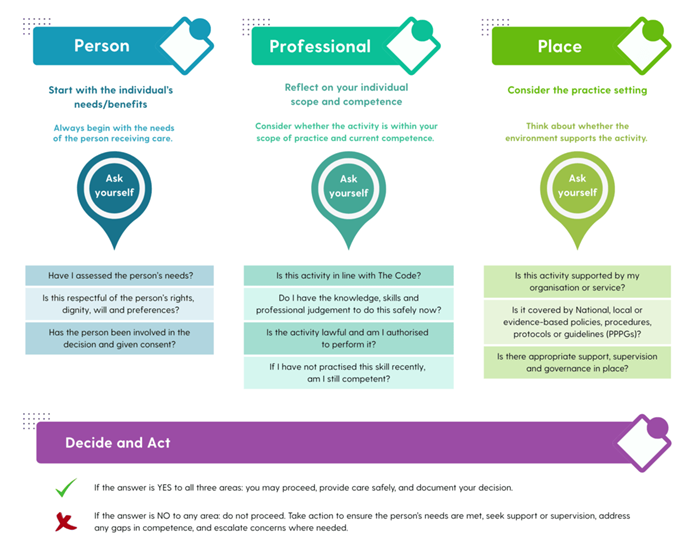
A practical way to support professional judgement is to use the NMBI Decision Making Framework outlined in the Code. The framework provides a structured approach to thinking through ethical and professional issues and supports safe, accountable decision making.
My unit has no phlebotomy service, and I have been asked to take blood. Am I covered to perform phlebotomy?
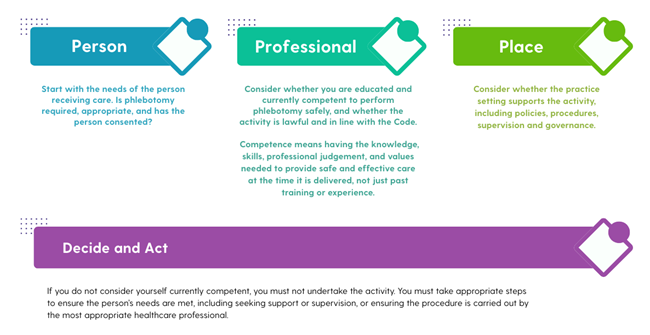
Your ability to perform phlebotomy depends on whether it falls within your own scope of practice.
As a regulated professional, you are accountable for your decisions and for the outcomes of the care you provide, regardless of your role, work setting, or whether you are working under direction or as part of a team. You must use the Code to guide your professional judgement and decision making, including decisions about your scope of practice.
Scope of practice refers to what a registered nurse or registered midwife can safely and appropriately do, in line with the Code. It is informed by your education, current competence, authority, division(s) of the Register and the population you are registered to care for.
A practical way to support professional judgement is to use the NMBI Decision Making Framework outlined in the Code. The framework provides a structured approach to thinking through ethical and professional issues and supports safe, accountable decision making.
Consider:
I am a Registered Psychiatric Nurse working as a practice nurse. My employer has asked me to set up a nurse led Well Woman Check service. Is this within my scope of practice?
Whether you can provide a Well Woman Check service depends on whether it is within your individual scope of practice. You must use the Code to guide your professional judgement and decision making, including decisions about your scope of practice. As a regulated professional, you are accountable for your decisions and for the outcomes of the care you provide, regardless of your role, work setting, or whether you are working under direction or as part of a team.
Scope of practice refers to what a registered nurse or registered midwife can safely and appropriately do, in line with The Code. It is informed by your education, current competence, authority, division(s) of the register and the population you are registered to care for.
Registered Psychiatric Nurses are educated and prepared to provide mental health care across a range of settings. This education does not usually include the population specific knowledge, physical health assessment skills, or supervised clinical experience required to safely provide Well Woman Checks.
Women’s health assessments, including Well Woman Checks, are generally within the scope of practice of registrants in the General Nursing and Midwifery divisions, whose education and clinical preparation support this type of care.
Being asked, directed, or expected by an employer to carry out a Well Woman Check does not, on its own, make the activity part of your scope of practice. You must use your professional judgement to decide whether you have the necessary education and current competence to provide the care safely.
If an activity is outside your education, preparation, or current competence, it is outside your scope of practice and you must not undertake it. You must ensure that the person receiving care is supported by, or referred to, the most appropriate healthcare professional.
I am a Clinical Nurse Specialist (CNS), how do I decide whether a referral, client group or clinical presentation is appropriate for me to review?
As a CNS or CMS, you are responsible and accountable for deciding whether a referral, client group, or clinical presentation falls within your individual scope of practice. This decision must be guided by the Code and your professional judgement.
Scope of practice means what you can safely and appropriately do based on your education, training and experience, your current competence, your role and area of expertise, and your registration and the population you are authorised to care for.
When considering a referral, you must be satisfied that you have the necessary knowledge, skills, and competence relevant to the person or group being referred. This includes considering your area of clinical expertise, your current competence, the needs and complexity of the person receiving care, the practice setting and supports available, and any relevant legislation, policies, and evidence based guidance.
As a regulated professional, you are accountable for your decision to accept or decline a referral and for the outcomes of the care you provide. You must only accept referrals where you can practise within your scope and competence, provide care that is safe and appropriate, and access the supports needed to deliver that care.
If a referral is outside your scope or competence, you must not accept it and should take appropriate action, such as redirecting or escalating the referral in line with local processes.
You must only review referrals that match your expertise, competence, and scope of practice, and you are personally accountable for making that decision and for the care that follows.
You remain accountable for your decisions and practice at all times, in line with the Code.
I am a nurse working in a GP practice. I am not a midwife. Is it possible to provide antenatal and post natal advice and care?
No. As a registered nurse, antenatal and postnatal clinical assessment or advice is outside your scope of practice. This care falls within the scope of practice of registered midwives. As a regulated professional, you are accountable for your decisions and for the outcomes of the care you provide, regardless of your role, work setting, or whether you are working under direction or as part of a team.
You must use the Code to guide your professional judgement and decision making, including decisions about your scope of practice. Whether you can provide antenatal or post natal advice or care depends on whether the activity is within your individual scope of practice, which you must determine using The Code.
Scope of practice refers to what a registered nurse or registered midwife can safely and appropriately do, in line with The Code. It is informed by your education, current competence, authority, division(s) of the Register, and the population you are registered to care for.
The provision of antenatal and post natal care, including clinical assessment and advice related to pregnancy and the post natal period, falls within the scope of practice of registrants in the Midwifery division of the register. A registered nurse who is not registered as a midwife does not have the population specific education, preparation or authorisation to provide this care.
As a result, providing antenatal or post natal advice or care is outside the scope of practice of a registered nurse who is not a midwife, regardless of the setting in which they work.
Where antenatal or post natal advice or care is required, you should ensure the person’s needs are met by the most appropriate healthcare professional, such as a registered midwife or a general practitioner.
What are my responsibilities when reviewing an individual's care plan?
When reviewing an individual’s care plan, you are accountable for making professional decisions guided by the Code. As a regulated professional, you are accountable for your decisions and for the outcomes of the care you provide, regardless of your role, work setting, or whether you are working under direction or as part of a team. Any changes to an individuals care plan must prioritise the person’s needs, rights, and preferences and must be safe, appropriate, and justified.
A practical way to support professional judgement is to use the NMBI Decision Making Framework outlined in the Code. The framework provides a structured approach to thinking through ethical and professional issues and supports safe, accountable decision making.
How do I apply this in practice?
PERSON- Start with the individual
You must begin by considering the person receiving care.
- Treat each person as an individual with their own rights, values and preferences.
- Where a person has capacity, you must seek, respect and document their views, wishes and consent.
- Has the individual had a comprehensive assessment establishing their individual health and cultural needs?
- Decisions about care must be person centred, based on an individual assessment, and informed by evidence.
- Any agreed changes to care must be clearly reflected in the care plan, with risks identified and regularly reviewed.
Respect is a core principle of the Code.
PROFESSIONAL – Reflect on your scope of practice
You must use your professional judgement to review the individuals needs and consider are they beyond your professional scope.
- Support the person to make informed decisions about their care, where appropriate.
- Consider whether the proposed actions are clinically justified, appropriate and safe.
- Explain and justify revision care plan is safe, appropriate, person centred, and consistent with the Code.
PLACE – Consider the practice context
You must consider whether the care environment supports the proposed changes.
- If changes to the care plan are identified are the activities/practices supported by evidence and within in the organisation?
- If any aspect of the care plan falls outside your competence or scope, you must seek appropriate input, refer, or escalate concerns in line with local policies and governance arrangements.
Do I need professional indemnity insurance to practice as a registered nurse or midwife?
Yes. Professional indemnity insurance helps protect both you and the person receiving care in the event of a claim arising from your professional practice.
As a regulated professional, you are accountable for your decisions and for the outcomes of the care you provide, regardless of your role, work setting, or whether you are working under direction or as part of a team. You are accountable for ensuring that you have appropriate and adequate professional indemnity insurance in place. This includes all clinical activities you undertake as part of your professional role.
The way professional indemnity insurance is arranged may differ depending on how you practise:
- If you are employed in the public or voluntary/not for profit sector, professional indemnity insurance is generally provided through your employer’s arrangements, for activities carried out within your contracted role and scope of employment.
- If you are employed in the private or independent sector, indemnity insurance may be provided by your employer, but this should not be assumed. You should confirm directly with your employer that appropriate indemnity insurance is in place and that it covers the nature and scope of the services you provide.
- If you provide services on a private or independent basis, or carry out any work outside your contracted employment, you are responsible for ensuring that you have your own individual professional indemnity insurance in place.
How does the Code define competence, and what are my responsibilities to maintain it?
Competence means having the knowledge, skills, professional judgement, and values needed to provide safe and effective care at the time the care is delivered. It is about being able to practise safely now, not just having qualifications, training, or experience from the past. You must only provide care that you are educated, trained, and currently competent to deliver, and that is within your scope of practice. Scope of practice refers to what a registered nurse or registered midwife can safely and appropriately do, in line with the Code. It is informed by your education, current competence, authority, division(s) of the register, and the population you are registered to care for.
You are required to use your professional judgement to decide what is safe and appropriate in each situation. You are also responsible for maintaining and developing your competence throughout your professional life, including taking part in continuing professional development to keep your knowledge and skills up to date.
If you identify a gap in your competence, you must take appropriate action, such as seeking education, supervision, or support. You must not carry out activities that are outside your current competence and should ensure that the person receiving care is supported by, or referred to, the most appropriate healthcare professional.
As a regulated professional, you remain personally accountable for your decisions, actions, omissions, and the outcomes of care, in line with the Code.
Do I need to be registered in the jurisdiction where the person receiving care is located when providing telehealth services?
Yes. If you provide telehealth services, you must be appropriately registered in the jurisdiction where the person receiving care is located at the time the care is provided.
You must comply with the laws, regulations, and privacy requirements that apply in that jurisdiction, in line with the Code and NMBI’s Guiding Principles for Telehealth Nursing and Midwifery (September 2024).
You must practise safely, legally, and within your individual scope of practice. Scope of practice refers to what a registered nurse or registered midwife can safely and appropriately do, in line with the Code. It is informed by your education, current competence, authority, division(s) of the Register, and the population you are registered to care for.
Professional accountability for practice always rests with you. You are personally answerable for your decisions, actions, omissions, and the outcomes of care, whether care is delivered in person or through telehealth.
How should registered nurses and registered midwives meet their professional responsibilities for documenting care in day to day clinical practice?
Accurate documentation is a core part of safe, person centred care.
- Documentation must reflect the care provided and the professional decisions you make, support continuity of care, and maintain the safety, rights, and dignity of the person receiving care.
- You are accountable for the records you create or contribute to.
- Organisational policies may support practice, but they do not replace your professional responsibility under the Code.
Further detail is set out below:
As a regulated professional, you are required to practise in accordance with The Code of Professional Conduct and Ethics for Registered Nurses and Registered Midwives. This includes meeting the standards for record keeping set out in the Code, regardless of your role, setting, or whether you are working under direction or as part of a team.
While local policies, procedures, and guidance may support documentation practice, responsibility for the quality and standard of documentation rests with you as the registrant. You are personally accountable for the records you create and for any entries you make in a shared or multidisciplinary record.
The documentation responsibilities of registered nurses and registered midwives are clearly set out in the Code, including under:
Section 4 applies to all registrants, in all practice settings and across all forms of documentation. It sets out expectations that records must be accurate, clear, timely, and secure, and that they appropriately document assessments, decisions, actions, evaluations, and communication relevant to a person’s care.
The Code makes clear that the standard of documentation is closely linked to the quality and safety of care provided, and that registrants are professionally and legally accountable for the records they produce.
Applying this in day to day practice
In everyday clinical practice, registered nurses and registered midwives must use their professional knowledge, skills, and judgement to ensure that documentation:
- Accurately reflects the care provided
- Clearly records the clinical reasoning behind decisions
- Supports continuity of care and effective communication
- Is completed in a timely and proportionate way
The Code recognises the realities of busy clinical environments. However, maintaining clear, accurate, and up to date records remains a core professional responsibility and is not optional. Registrants are expected to apply the principles of the Code to their daily documentation practice.
In line with the Code, registered nurses and registered midwives are accountable for their professional practice, including their decisions, actions, omissions, and the outcomes arising from them. This accountability includes the standard and quality of the documentation they produce.
Why is it recommended for nurses and midwives to include their NMBI PIN number in patient charts?
Including your NMBI PIN in patient charts helps ensure that you can be clearly identified as the professional responsible for the care delivered. This supports professional accountability, transparency, and the integrity of healthcare records.
You are required to maintain clear, accurate, and accountable records of the care you provide in line with The Code of Professional Conduct and Ethics for Registered Nurses and Registered Midwives. Accurate documentation in patient records reflects both the care provided and the quality of that care.
Professional accountability for practice always rests with you. You are answerable for what you do, the decisions you make, and the outcomes of those decisions.
How should I decide what advice can be safely given over the phone when an individual calls the ward with a health query?
When providing advice over the phone, you must follow NMBI’s Guiding Principles for Telehealth Nursing and Midwifery and use the NMBI Code to guide your professional judgement to decide whether it is safe and appropriate to provide advice by phone.
As a regulated professional, you are required to practise in accordance with the Code whether care is provided in person, over the phone, or through telehealth. Any advice given must be within your individual scope of practice and current competence.
Before giving advice, you should:
- decide whether the person’s needs can be safely met over the phone or whether face to face assessment, referral, or urgent review is required
- confirm the person’s identity and location and gather sufficient and relevant information to support decision making
- recognise the limitations of phone based assessment, including the inability to observe or examine the person directly
- not proceed if safe care cannot be provided by phone and advise on appropriate next steps.
Any advice given must be evidence based, clearly explained, and appropriate to the person’s circumstances. You should check the person’s understanding and provide clear safety net advice where appropriate, including when and how to seek further or urgent care. Local policies, procedures, and protocols may support nurses in responding to telephone enquiries and documenting care.
Professional accountability for practice rests with you. You are answerable for what you do, the decisions you make, and the outcomes of those decisions.
How should advice given over the phone be documented?
Documentation of phone advice should reflect the Guiding Principles for Telehealth Nursing and Midwifery and the NMBI Code. Records should clearly include the information obtained, your assessment and clinical reasoning, the advice given, and any follow up actions, referrals, or safety net advice provided.
Documentation must be factual, proportionate, and completed as soon as practical after the interaction. Organisational policies may support documentation practice, but responsibility for meeting the standards set out in the Code rests with you as the registrant.
Registered nurses and registered midwives are required to document care accurately, clearly, and in a timely manner, in line with the Code . As a regulated professional you are accountable for the records you create or contribute to, regardless of your role, work setting, or workload. Professional accountability for practice rests with you. You are answerable for what you do, the decisions you make, and the outcomes of those decisions.
What guidance does the Nursing and Midwifery Board of Ireland provide regarding the safe and professional management of medications?
Can I administer vaccinations as a registered nurse or midwife?
Yes, you may administer vaccinations if this is within your individual scope of practice.
As a regulated professional, you are accountable for your decisions and for the outcomes of the care you provide, regardless of your role, work setting, or whether you are working under direction or as part of a team. You must use the Code to guide your professional judgement and decision making, including decisions about your scope of practice.
Scope of practice refers to what a registered nurse or registered midwife can safely and appropriately do. It is informed by education, current competence, authority, division(s) of the Register, and the population you are registered to care for.
A practical way to support professional judgement in relation to the administration of vaccinations is to use the NMBI Decision Making Framework outlined in the Code. The framework provides a structured approach to ethical and professional decision making by considering the individual, the professional, and the practice setting.
When deciding whether to administer vaccinations, you should consider:
PERSON - The individual receiving care
- Is vaccination appropriate for the person’s individual health needs?
- Can valid consent be obtained?
- Can you safely assess, monitor, and respond to any risks, including adverse reactions?
PROFESSIONAL - You as the professional – reflect on your scope of practice
- Does administering vaccinations align with your individual scope of practice, including the division(s) of the register you are entered on and the population you are registered to care for?
- Are you educated, trained, and currently competent to administer vaccinations, including managing contraindications and adverse events?
PRACTICE - The practice setting
- Are appropriate policies, procedures, equipment, and emergency supports in place?
- Is the activity supported by national and professional guidance, including NMBI’s Guidance for Registered Nurses and Registered Midwives on Medication Administration (2020)?
Decide and Act
If, having considered the person, your scope and competence, and the practice setting, you determine that you are not currently competent, you must not undertake the activity. You must take appropriate steps to ensure the person’s needs are met, such as seeking support or supervision to develop competence where appropriate, or ensuring the vaccination is provided by the most appropriate healthcare professional.
Registrants should also have regard to relevant national and professional guidance that supports safe vaccination practice, including:
Vaccination scope: Key reminders
- You may only administer vaccinations if this is within your individual scope of practice.
- Your scope of practice is informed by your education, current competence, division(s) of the Register, authorisation, and the population you are registered to care for, in line with the Code.
- Always apply the NMBI Decision Making Framework by considering the individual receiving care, you as the professional, and the practice setting.
- Being asked, directed, or expected by an employer to administer a vaccine does not extend your scope of practice.
- You must be currently competent to administer vaccinations safely, including assessing suitability, obtaining consent, monitoring for adverse reactions, and responding to emergencies.
- Vaccination practice must be supported by appropriate policies, procedures, equipment, and clinical governance arrangements.
- You must practise in line with NMBI’s Guidance for Registered Nurses and Midwives on Medication Administration (2020) and relevant national immunisation guidance.
- If administering vaccinations is outside your scope or competence, you must not proceed and must ensure the person receives care from the most appropriate healthcare professional.
- You are personally accountable for your decisions, actions, omissions, and the outcomes of care provided, in line with the Code.
Can I administer vaccinations as a nurse/midwife when there is no doctor on site?
You may administer vaccinations in the absence of a doctor where this is within your individual scope of practice and with regard to professional and national guidance documents. There is no requirement in legislation or in NMBI standards for a doctor to be physically present when a registered nurse or registered midwife administers a vaccine.
Scope of practice means that:
- You have the appropriate education, training, and current competence to administer the vaccine safely, including the ability to assess, monitor, and respond to risks such as adverse reactions.
- The practice setting has appropriate policies, procedures, protocols, and clinical governance arrangements in place.
- The activity is carried out in accordance with the Code of Professional Conduct and Ethics for Registered Nurses and Registered Midwives, including the Scope of Practice and Professional Guidance (NMBI, 2025) and NMBI’s Guidance for Registered Nurses and Registered Midwives on Medication Administration (2020).
In line with the Code, registered nurses and registered midwives are personally accountable for their professional practice, including their decisions, actions, omissions, and the outcomes arising from the administration of vaccinations. You must ensure that care is delivered safely and in line with the needs, rights, and wishes of the individual receiving the vaccine.
Can a registered midwife administer childhood vaccinations in a GP practice?
No. The scope of practice of a registered midwife includes care during the antenatal, intranatal, and postnatal periods, with the postnatal period defined as up to six weeks following delivery. As primary childhood immunisation schedules generally begin at eight weeks, administering these vaccinations falls outside the scope of midwifery practice.
Scope of practice refers to what a registered nurse or registered midwife can safely and appropriately do, in line with the Code. It is informed by your education, current competence, authority, division(s) of the Register and the population you are registered to care for.
Working in a GP practice or being asked by an employer to carry out a task does not extend scope of practice. If an activity is outside their scope, a midwife must not carry it out and should refer to an appropriate healthcare professional.
As a regulated professional, you are accountable for your decisions and for the outcomes of the care you provide, regardless of your role, work setting, or whether you are working under direction or as part of a team.
Are registered nurses and midwives required by NMBI to double-check medications as part of their role in administering medications?
No. There is no legal or NMBI requirement that medications must be double checked as part of the nurse or midwife’s role in medication administration.
It is first helpful to clarify what is meant by double checking. An independent double check, sometimes referred to as independent verification, involves one nurse or midwife carrying out their own calculation or check of the medication and then comparing this with a colleague. This is a safety measure, not a regulatory requirement.
NMBI recognises that there are many practice settings where a nurse or midwife may be working alone, such as in community settings, residential care units, or during night duty. In these circumstances, it is not always possible to carry out a double check, and the absence of an independent verifier does not in itself prevent medication administration.
For patient safety and risk management purposes, health service providers may require double checking of certain medicines as per local policies, procedures, protocols, and guidelines. This may particularly be the case for medicines considered high risk or high alert, or where complex calculations are required. These requirements are determined at organisational level, not by NMBI or legislation.
As with all medication administration, professional accountability rests with the nurse or midwife administering the medicine. You must apply professional judgement, practise within your individual scope of practice, and administer medicines safely in line with medicines legislation, NMBI guidance, and local policy, regardless of whether an independent verifier is involved or not.
Can a nursing or midwifery student act as a cosigner for MDA Schedule 2 drug checks, or is this role limited to me as a registered nurse or midwife?
A nursing or midwifery student may act as a second checker where this is permitted by local policy and it is appropriate to their level of education and competence, as assessed by their supervisor. Where a student is involved, the registrant as the regulated professional remains accountable for ensuring that medicines are checked and administered safely and in line with the Code, medicines legislation, and NMBI guidance.
All registered nurses and registered midwives must practise medication management in line with the Code, relevant medicines legislation, and regulatory guidance on medication management, including:
As a regulated professional, you are accountable for the safe preparation, checking, and administration of medicines, including controlled drugs. This must be carried out within your individual scope of practice, which is informed by your education, current competence, authority, division(s) of the Register, and the population you are registered to care for.
A two person check for medicines administration, including controlled drugs, is an organisational requirement as part of safe medication management and not a legal one. One of the individuals involved in checking medication administration must be a registered nurse or midwife, and decisions about who may act as the second checker are determined by local policy.
Can a medication protocol be used to support person-centred, timely care?
Yes. A medication protocol may be used by a healthcare organisation to support person centred, timely, and safe care, where it is developed and implemented in line with NMBI’s Guidance to Nurses and Midwives on Medication Management (2007). This guidance sets out the regulatory expectations for medication protocols and supports their use to authorise nurses and midwives to supply and administer specified medicines to defined groups of individuals in clearly identified clinical circumstances, where supported by local policy.
Medication protocols must be developed and governed appropriately. This includes evidence based development, multidisciplinary oversight, clearly defined inclusion and exclusion criteria, transparent accountability arrangements, and regular monitoring, audit, and review, as outlined in the 2007 guidance.
When working under a medication protocol, you must practise within your individual scope of practice and continue to exercise professional judgement. The use of a protocol does not replace professional judgement or remove responsibility for safe care. In line with the Code, you remain personally accountable for your decisions, actions, and the outcomes of care.
The Code of Professional Conduct and Ethics for Registered Nurses and Registered Midwives (NMBI, 2025) reinforces that care must be person centred, respecting the individual’s rights, values, preferences, and expressed wishes. Nurses and midwives are required to support individuals to participate in decisions about their care and to ensure that care is delivered safely, ethically, and in accordance with professional standards.
When appropriately designed and governed, a medication protocol can support timely responses to assessed needs and facilitate access to treatment, while maintaining person centred decision making and full professional accountability for the care provided.
Can a Registered Nurse Prescriber prescribe a Schedule 2 MDA drug such as methylphenidate?
Yes. Registered Nurse Prescribers (RNPs) and Registered Midwife Prescribers (RMPs) may prescribe certain controlled drugs, including some Schedule 2 MDA medicines such as methylphenidate, where this is explicitly permitted under medicines and controlled drugs legislation and where prescribing is in line with NMBI professional regulatory requirements.
Prescriptive authority for controlled drugs is governed by medicines and controlled drugs legislation, including:
- Misuse of Drugs (Amendment) Regulations 2007, specifically Schedule 8, and
- Misuse of Drugs Regulations 2017 (S.I. No. 173/2017)
Schedule 8 sets out the controlled drugs that may be prescribed by nurse and midwife prescribers and the conditions under which prescribing may occur. Only those Schedule 2 MDA medicines listed in Schedule 8 may be prescribed by RNPs or RMPs.
Where medicines or controlled drugs legislation does not provide authority for nurse or midwife prescribing of a particular controlled drug, prescribing is not permitted, even if the registrant is clinically competent or holds NMBI prescriptive authority.
In addition to legislation, prescribing must be carried out in line with NMBI professional standards, including:
You may prescribe Schedule 2 MDA medicines only for individuals you have personally assessed, and only where prescribing is within your individual scope of practice and current competence.
All registrants remain professionally accountable for their prescribing decisions. In accordance with the Code, nurses and midwives must uphold the values of the profession, exercise sound clinical judgement, and ensure that their practice reflects high standards of professional conduct and public protection.
What guidance is provided for the aesthetics industry, specifically in relation to the administration of Botox?
Can a nurse administer medication to patients using a Healthmail prescription?
Yes. A nurse may administer medication based on a valid Healthmail prescription, provided the prescription complies with medicines and controlled drugs legislation and with relevant professional and organisational requirements.
Under the Medicinal Products (Prescription and Control of Supply) (Amendment) Regulations 2020 (S.I. No. 98/2020), the HSE’s Healthmail service is the approved National Electronic Prescription Transfer System. A Healthmail prescription is legally valid where it is transmitted in a permanent, unalterable electronic form and is electronically traceable to the prescriber. It must meet all statutory prescription requirements, including the date of issue and the prescriber’s professional registration number. A handwritten signature is not required, as Healthmail prescriptions are authenticated electronically and must remain in their original, unaltered format.
For Schedule 2 and Schedule 3 controlled drugs, all statutory requirements relating to controlled drug prescriptions continue to apply. While these requirements include specific legal content and format elements, the prescription does not need to be handwritten where it is transmitted through an approved electronic system and is fully traceable to the prescriber. In all cases, the pharmacist must be satisfied that the prescription is legally valid and that dispensing is clinically appropriate within their professional judgement.
A registered nurse may administer medication on foot of a valid Healthmail prescription where the prescription meets legislative requirements and where administration is carried out in accordance with local organisational policies, procedures, protocols, and guidelines (PPPGs).
As with all medication management, you remain accountable for your practice. This includes compliance with the Code of Professional Conduct and Ethics for Registered Nurses and Registered Midwives (NMBI, 2025), Guidance for Registered Nurses and Midwives on Medication Administration (NMBI, 2020), and Guidance to Nurses and Midwives on Medication Management (NMBI, 2007).
These require nurses to apply professional judgement, practise within their individual scope of practice, and ensure that medicines are administered safely and in accordance with applicable legislation.
How frequently should preceptorship be undertaken in clinical practice?
NMBI does not prescribe a specific timeframe for how often preceptorship training must be undertaken or refreshed. As the regulator, NMBI sets standards for professional practice and conduct through the Code of Professional Conduct and Ethics for Registered Nurses and Registered Midwives incorporating the Scope of Practice and Professional Guidance (NMBI, 2025) and through the Registered Midwife Programmes Standards and Registered Nurse Programmes Standards rather than specifying mandatory renewal intervals.
Preceptors are required to maintain their competence in line with the Code. This means being uptodate facilitating learning in a quality learning environment, supervising, and assessing students fairly, consistently, and respectfully, using approved standards and criteria. Registrants have an individual professional responsibility to recognise when updates or further development are needed to support their role as a preceptor.
Education bodies are responsible for ensuring that appropriate education, preparation, and ongoing development opportunities are available to support preceptors in carrying out their role effectively.
NMBI reviews standards relating to the supervision of students in practice learning environments at least every five years, or more frequently where required, to ensure they remain appropriate and effective.
At local level, health service providers may set their own expectations for how often preceptorship updates should be completed. Registrants should check local policies and requirements with their line manager or practice development team.
Who has responsibility for ensuring that undergraduate programmes meet standards for the student’s learning experience?
Education bodies have overall responsibility for ensuring that undergraduate programmes meet required standards for the student learning experience, including practice placement areas. NMBI, as the regulator, sets these standards and monitors compliance through programme approval and inspection. Any issues experienced by students on placement should be raised through the Education body’s established reporting structures, such as the Clinical Placement Coordinator, link lecturers, or SALO.
Does a full week of night duty count toward the required 36‑week internship?
Yes. Under the NMBI
Registered Nurse Programme Standards, the 36 week internship includes all rostered weeks, including annual leave.
If a student completes a full week of night duty, where the hours worked are equivalent to two rostered weeks, the following week off is considered rostered time off. This week still counts toward the 36‑week internship requirement.
For any individual circumstances or clarification, students should contact their education body or clinical representative (e.g., CPC) responsible for student practice learning.
As a programme provider, how can I award Continuing Professional Development (CPD) hours to a nurse or midwife?
Please refer to our guidance for programme providers on two pathways for awarding CPD hours.
- Short course pathway: this is where programme providers are guided on how to award CPD hours for a range of educational activities. This checklist does not need to be submitted to NMBI for approval.
- Competency-based programme pathway: this is where programme providers are guided on submission criteria required to apply for NMBI programme approval.
The guidance and forms are available on the NMBI website.
What is the Category 2 or equivalent approval process?
Full information and the application process for NMBI Category 2 or equivalent approval can be found here. Please be aware that specialist allowances are approved by the employer and not by NMBI. NMBI will review and verify if the course/ programme completed is approved as a Category 2 or equivalent programme but does not grant or advise employers on specialist allowances.
Is there a list of approved post-registration courses?
NMBI approve post-registration courses in the Republic of Ireland. These courses have gone through our programme approval processes. A list of NMBI approved programmes is available on our website and can be found here.
What courses must I undertake if I wish to return to nursing practice work?
For nurses and midwives that have been out of practice for 5 years or over, it is recommended that they complete a return to nursing or midwifery programme. This is for the employer to decide as it is not a requirement for registration.
Important Information for Registrants - Professional Accountability: What It Means for You
As a registered nurse or midwife, you must practise in line with the Code of Professional Conduct and Ethics (NMBI, 2025). The Code applies to all registered nurses and midwives, including those in roles as educators, leaders, and managers and anyone who informs, influences, or delivers nursing or midwifery care. Using the Code is a fundamental requirement of professional regulation.
What is professional accountability?
Professional accountability means you are responsible for your own practice at all times, including your: Decisions, Actions, Omissions (what you fail to do) and the outcomes of the care you provide. This applies in all roles and settings.
Accountability cannot be transferred, you cannot delegate or pass accountability to another person, and even when working under direction or as part of a team, you remain responsible for ensuring your practice is within your scope, within your competence, and safe and appropriate to the care provided.
Professional accountability is essential to protecting the public, ensuring care is safe, effective, and based on sound professional judgement. For you as a Professional, accountability means you own your practice. It is a fundamental requirement of registration and a key safeguard for the public.
Who is responsible for deciding matters such as day duty and night duty for nurses and midwives?
Matters relating to staff rostering are the responsibility of employers not NMBI. These issues should be addressed through local employment arrangements.
What guidance does NMBI give regarding individual employment issues or day-to-day service delivery matters?
NMBI does not provide guidance on individual employment issues or on day-to-day service delivery matters.
If you have concerns about things like your working conditions, staffing levels, supervision, or how your workplace is organised, you should raise these locally first. This usually means speaking to your line manager or employer to try to resolve the issue.
If you have concerns about professional conduct, competence, or patient safety that cannot be resolved at a local level, these may need to be referred to NMBI as part of its role as the regulator.
Does NMBI advise on specific indemnity insurance or recommend insurance providers?
No. NMBI does not advise on professional indemnity insurance policies and does not recommend specific insurance providers.
All registered nurses and registered midwives must ensure that they have appropriate and adequate professional indemnity insurance in place for the care and services they provide in line with the Code.
As a regulated professional, you are accountable for your decisions and for the the care you provide, regardless of your role, work setting, or whether you are working under direction or as part of a team.
The way professional indemnity insurance is arranged may differ depending on how you practise:
- If you are employed in the public or voluntary/not for profit sector, professional indemnity insurance is generally provided through your employer’s arrangements, for activities carried out within your contracted role and scope of employment.
- If you are employed in the private or independent sector, indemnity insurance may be provided by your employer, but this should not be assumed. You should confirm directly with your employer that appropriate indemnity insurance is in place and that it covers the nature and scope of the services you provide.
- If you provide services on a private or independent basis, or carry out any work outside your contracted employment, you are responsible for ensuring that you have your own individual professional indemnity insurance in place.
You should ensure that your indemnity insurance arrangements are appropriate to your scope of practice and service you provide. Scope of practice refers to what a registered nurse or registered midwife can safely and appropriately do, in line with The Code. It is informed by your education, current competence, authority, division(s) of the Register and the population you are registered to care for.
Does NMBI provide guidance on setting up a private clinic or independent service?
No. NMBI does not regulate business or company formation, private practice governance, or the legal and operational requirements involved in setting up a private clinic or independent healthcare service. These matters fall outside the role of the nursing and midwifery regulator.
If you are considering setting up a private clinic or providing independent services, you should seek advice from legal and professional experts with experience in healthcare regulation, business formation, and private practice governance. As a regulated professional, you are accountable for ensuring that you have appropriate and adequate professional indemnity insurance in place. Your insurance must cover your scope of practice.
Scope of practice refers to what a registered nurse or registered midwife can safely and appropriately do, in line with the Code. It is informed by your education, current competence, authority, division(s) of the register and the population you are registered to care for.
Accountability for practice always rests with you as the registrant. This means you are personally answerable for what you do, the decisions you make, anything you choose not to do, and the outcomes of your care. This accountability cannot be passed to someone else, even if you are working under direction or as part of a team.