The Code
Important Information for Registrants - Professional Accountability: What It Means for You
As a registered nurse or midwife, you must practise in line with the Code of Professional Conduct and Ethics (NMBI, 2025). The Code applies to all registered nurses and midwives, including those in roles as educators, leaders, and managers and anyone who informs, influences, or delivers nursing or midwifery care. Using the Code is a fundamental requirement of professional regulation.
What is professional accountability?
Professional accountability means you are responsible for your own practice at all times, including your: Decisions, Actions, Omissions (what you fail to do) and the outcomes of the care you provide. This applies in all roles and settings.
Accountability cannot be transferred, you cannot delegate or pass accountability to another person, and even when working under direction or as part of a team, you remain responsible for ensuring your practice is within your scope, within your competence, and safe and appropriate to the care provided.
Professional accountability is essential to protecting the public, ensuring care is safe, effective, and based on sound professional judgement. For you as a Professional, accountability means you own your practice. It is a fundamental requirement of registration and a key safeguard for the public.
What is the Code of Professional Conduct and Ethics for Registered Nurses and Registered Midwives?
The Code of Professional Conduct and Ethics for Registered Nurses and Registered Midwives, incorporating the Scope of Practice and Professional Guidance, The Code (NMBI, 2025), is the primary guidance document for all registered nurses and registered midwives in Ireland. The Code supports and guides you in:
- ethical decision-making and professional practice
- maintaining safe, effective, compassionate, and person-centred care
- recognising and responding to the needs of patients, clients, service-users, families, and women receiving maternity care
- ongoing professional development and maintenance of professional competence
The Code also informs the public, employers, and other stakeholders of the standards of professional conduct and behaviour expected of registered nurses and registered midwives and provides a benchmark against which professional conduct may be assessed.
The Code is built around six core principles, which describe what good professional practice looks like and what standards are expected of you as a registrant:
- Respect
- Accountability
- Competence
- Trust
- Collaboration
- Leadership
Together, these principles support safe, ethical and effective care and help you understand your professional responsibilities. The Code also includes key professional guidance to support your day to day practice, including:
Irrespective of your role as a nurse, midwife, educator, manager, or leader, you must:
- know the Code and stay familiar with its principles and guidance
- use it to guide your decisions and actions in your work
- apply it to your role, including care delivery, education, leadership, or management
- maintain your competence and act safely and ethically
- be able to demonstrate that your actions align with the Code. In short, the Code should guide how you think, act, and make decisions in all aspects of your professional role.
As a regulated professional what am I accountable for?
As a regulated professional, you are accountable for your ethical decision-making and professional practice.
Accountability for ethical decision-making and professional practice rests with you as the registrant. This means you are personally answerable for what you do, the decisions you make, anything you choose not to do, and the outcomes of your care. This accountability cannot be passed to someone else, even if you are working under direction or as part of a team.
In practice, this means you are accountable for:
- practising in line with The Code, relevant legislation, and professional standards
- the decisions you make about the care you provide
- the professional judgements and actions you take, and omissions or anything you choose not to do
- ensuring your practice is within your scope of practice and current competence
- speaking up or taking action if a situation is unsafe or outside your scope
Being asked, directed, or expected to carry out an activity does not remove your accountability. You must always use your professional judgement to decide what is safe, appropriate, and within your scope of practice.
How do I decide if I can carry out an activity within my scope of practice?
You must use the Code to guide your professional judgement and decision-making, including decisions about your scope of practice. As a regulated professional, you are accountable for your decisions and for the outcomes of the care you provide, regardless of your role, work setting, or whether you are working under direction or as part of a team.
Scope of practice refers to what a registered nurse or registered midwife can safely and appropriately do, in line with the Code. It is informed by your education, current competence, authority, division(s) of the register and the population you are registered to care for.
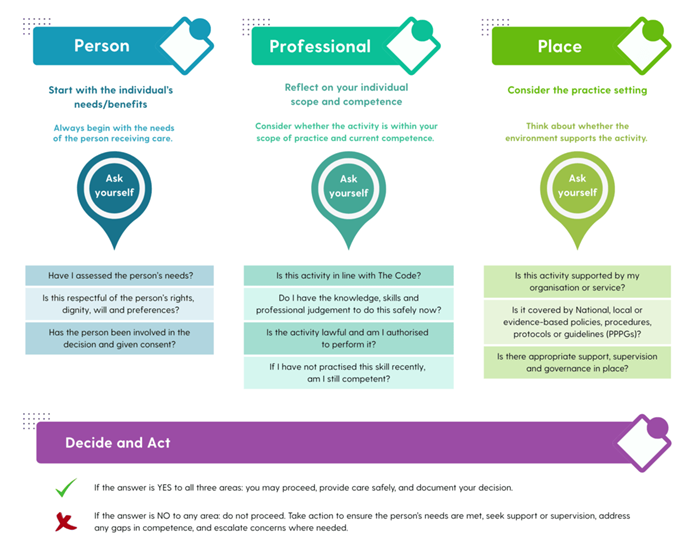
A practical way to support professional judgement is to use the NMBI Decision Making Framework outlined in the Code. The framework provides a structured approach to thinking through ethical and professional issues and supports safe, accountable decision making.
My unit has no phlebotomy service, and I have been asked to take blood. Am I covered to perform phlebotomy?
Your ability to perform phlebotomy depends on whether it falls within your own scope of practice.
As a regulated professional, you are accountable for your decisions and for the outcomes of the care you provide, regardless of your role, work setting, or whether you are working under direction or as part of a team. You must use the Code to guide your professional judgement and decision making, including decisions about your scope of practice.
Scope of practice refers to what a registered nurse or registered midwife can safely and appropriately do, in line with the Code. It is informed by your education, current competence, authority, division(s) of the Register and the population you are registered to care for.
A practical way to support professional judgement is to use the NMBI Decision Making Framework outlined in the Code. The framework provides a structured approach to thinking through ethical and professional issues and supports safe, accountable decision making.
Consider:
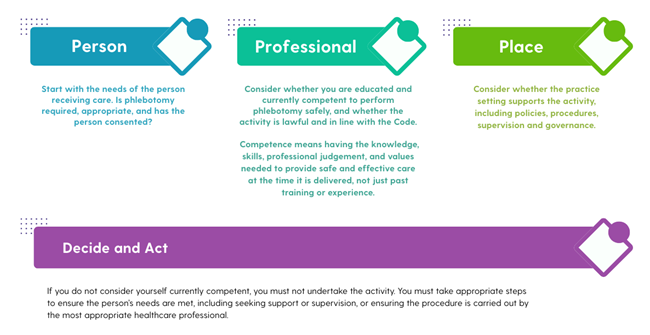
Being asked, directed, or expected to perform phlebotomy does not, on its own, mean the activity is within your scope of practice.
I am a Registered Psychiatric Nurse working as a practice nurse. My employer has asked me to set up a nurse led Well Woman Check service. Is this within my scope of practice?
Whether you can provide a Well Woman Check service depends on whether it is within your individual scope of practice. You must use the Code to guide your professional judgement and decision making, including decisions about your scope of practice. As a regulated professional, you are accountable for your decisions and for the outcomes of the care you provide, regardless of your role, work setting, or whether you are working under direction or as part of a team.
Scope of practice refers to what a registered nurse or registered midwife can safely and appropriately do, in line with The Code. It is informed by your education, current competence, authority, division(s) of the register and the population you are registered to care for.
Registered Psychiatric Nurses are educated and prepared to provide mental health care across a range of settings. This education does not usually include the population specific knowledge, physical health assessment skills, or supervised clinical experience required to safely provide Well Woman Checks.
Women’s health assessments, including Well Woman Checks, are generally within the scope of practice of registrants in the General Nursing and Midwifery divisions, whose education and clinical preparation support this type of care.
Being asked, directed, or expected by an employer to carry out a Well Woman Check does not, on its own, make the activity part of your scope of practice. You must use your professional judgement to decide whether you have the necessary education and current competence to provide the care safely.
If an activity is outside your education, preparation, or current competence, it is outside your scope of practice and you must not undertake it. You must ensure that the person receiving care is supported by, or referred to, the most appropriate healthcare professional.
I am a Clinical Nurse Specialist (CNS), how do I decide whether a referral, client group or clinical presentation is appropriate for me to review?
As a CNS or CMS, you are responsible and accountable for deciding whether a referral, client group, or clinical presentation falls within your individual scope of practice. This decision must be guided by the Code and your professional judgement.
Scope of practice means what you can safely and appropriately do based on your education, training and experience, your current competence, your role and area of expertise, and your registration and the population you are authorised to care for.
When considering a referral, you must be satisfied that you have the necessary knowledge, skills, and competence relevant to the person or group being referred. This includes considering your area of clinical expertise, your current competence, the needs and complexity of the person receiving care, the practice setting and supports available, and any relevant legislation, policies, and evidence based guidance.
As a regulated professional, you are accountable for your decision to accept or decline a referral and for the outcomes of the care you provide. You must only accept referrals where you can practise within your scope and competence, provide care that is safe and appropriate, and access the supports needed to deliver that care.
If a referral is outside your scope or competence, you must not accept it and should take appropriate action, such as redirecting or escalating the referral in line with local processes.
You must only review referrals that match your expertise, competence, and scope of practice, and you are personally accountable for making that decision and for the care that follows.
You remain accountable for your decisions and practice at all times, in line with the Code.
I am a nurse working in a GP practice. I am not a midwife. Is it possible to provide antenatal and post natal advice and care?
No. As a registered nurse, antenatal and postnatal clinical assessment or advice is outside your scope of practice. This care falls within the scope of practice of registered midwives. As a regulated professional, you are accountable for your decisions and for the outcomes of the care you provide, regardless of your role, work setting, or whether you are working under direction or as part of a team.
You must use the Code to guide your professional judgement and decision making, including decisions about your scope of practice. Whether you can provide antenatal or post natal advice or care depends on whether the activity is within your individual scope of practice, which you must determine using The Code.
Scope of practice refers to what a registered nurse or registered midwife can safely and appropriately do, in line with The Code. It is informed by your education, current competence, authority, division(s) of the Register, and the population you are registered to care for.
The provision of antenatal and post natal care, including clinical assessment and advice related to pregnancy and the post natal period, falls within the scope of practice of registrants in the Midwifery division of the register. A registered nurse who is not registered as a midwife does not have the population specific education, preparation or authorisation to provide this care.
As a result, providing antenatal or post natal advice or care is outside the scope of practice of a registered nurse who is not a midwife, regardless of the setting in which they work.
Where antenatal or post natal advice or care is required, you should ensure the person’s needs are met by the most appropriate healthcare professional, such as a registered midwife or a general practitioner.
What are my responsibilities when reviewing an individual's care plan?
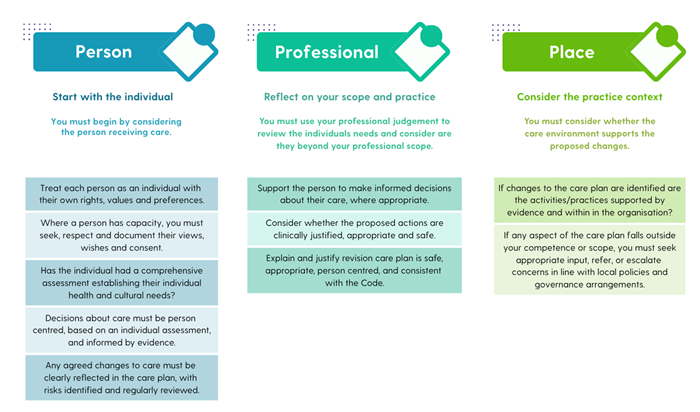
When reviewing an individual’s care plan, you are accountable for making professional decisions guided by the Code. As a regulated professional, you are accountable for your decisions and for the outcomes of the care you provide, regardless of your role, work setting, or whether you are working under direction or as part of a team. Any changes to an individuals care plan must prioritise the person’s needs, rights, and preferences and must be safe, appropriate, and justified.
A practical way to support professional judgement is to use the NMBI Decision Making Framework outlined in the Code. The framework provides a structured approach to thinking through ethical and professional issues and supports safe, accountable decision making.
How do I apply this in practice?
Do I need professional indemnity insurance to practice as a registered nurse or midwife?
Yes. Professional indemnity insurance helps protect both you and the person receiving care in the event of a claim arising from your professional practice.
As a regulated professional, you are accountable for your decisions and for the outcomes of the care you provide, regardless of your role, work setting, or whether you are working under direction or as part of a team. You are accountable for ensuring that you have appropriate and adequate professional indemnity insurance in place. This includes all clinical activities you undertake as part of your professional role.
The way professional indemnity insurance is arranged may differ depending on how you practise:
- If you are employed in the public or voluntary/not for profit sector, professional indemnity insurance is generally provided through your employer’s arrangements, for activities carried out within your contracted role and scope of employment.
- If you are employed in the private or independent sector, indemnity insurance may be provided by your employer, but this should not be assumed. You should confirm directly with your employer that appropriate indemnity insurance is in place and that it covers the nature and scope of the services you provide.
- If you provide services on a private or independent basis, or carry out any work outside your contracted employment, you are responsible for ensuring that you have your own individual professional indemnity insurance in place.
How does the Code define competence, and what are my responsibilities to maintain it?
Competence means having the knowledge, skills, professional judgement, and values needed to provide safe and effective care at the time the care is delivered. It is about being able to practise safely now, not just having qualifications, training, or experience from the past. You must only provide care that you are educated, trained, and currently competent to deliver, and that is within your scope of practice. Scope of practice refers to what a registered nurse or registered midwife can safely and appropriately do, in line with the Code. It is informed by your education, current competence, authority, division(s) of the register, and the population you are registered to care for.
You are required to use your professional judgement to decide what is safe and appropriate in each situation. You are also responsible for maintaining and developing your competence throughout your professional life, including taking part in continuing professional development to keep your knowledge and skills up to date.
If you identify a gap in your competence, you must take appropriate action, such as seeking education, supervision, or support. You must not carry out activities that are outside your current competence and should ensure that the person receiving care is supported by, or referred to, the most appropriate healthcare professional.
As a regulated professional, you remain personally accountable for your decisions, actions, omissions, and the outcomes of care, in line with the Code.
Do I need to be registered in the jurisdiction where the person receiving care is located when providing telehealth services?
Yes. If you provide telehealth services, you must be appropriately registered in the jurisdiction where the person receiving care is located at the time the care is provided.
You must comply with the laws, regulations, and privacy requirements that apply in that jurisdiction, in line with the Code and NMBI’s Guiding Principles for Telehealth Nursing and Midwifery (September 2024).
You must practise safely, legally, and within your individual scope of practice. Scope of practice refers to what a registered nurse or registered midwife can safely and appropriately do, in line with the Code. It is informed by your education, current competence, authority, division(s) of the Register, and the population you are registered to care for.
Professional accountability for practice always rests with you. You are personally answerable for your decisions, actions, omissions, and the outcomes of care, whether care is delivered in person or through telehealth.
How should registered nurses and registered midwives meet their professional responsibilities for documenting care in day to day clinical practice?
Accurate documentation is a core part of safe, person centred care.
- Documentation must reflect the care provided and the professional decisions you make, support continuity of care, and maintain the safety, rights, and dignity of the person receiving care.
- You are accountable for the records you create or contribute to.
- Organisational policies may support practice, but they do not replace your professional responsibility under the Code.
Further detail is set out below:
As a regulated professional, you are required to practise in accordance with The Code of Professional Conduct and Ethics for Registered Nurses and Registered Midwives. This includes meeting the standards for record keeping set out in the Code, regardless of your role, setting, or whether you are working under direction or as part of a team.
While local policies, procedures, and guidance may support documentation practice, responsibility for the quality and standard of documentation rests with you as the registrant. You are personally accountable for the records you create and for any entries you make in a shared or multidisciplinary record.
The documentation responsibilities of registered nurses and registered midwives are clearly set out in the Code, including under:
Section 4 applies to all registrants, in all practice settings and across all forms of documentation. It sets out expectations that records must be accurate, clear, timely, and secure, and that they appropriately document assessments, decisions, actions, evaluations, and communication relevant to a person’s care.
The Code makes clear that the standard of documentation is closely linked to the quality and safety of care provided, and that registrants are professionally and legally accountable for the records they produce.
Applying this in day to day practice
In everyday clinical practice, registered nurses and registered midwives must use their professional knowledge, skills, and judgement to ensure that documentation:
- Accurately reflects the care provided
- Clearly records the clinical reasoning behind decisions
- Supports continuity of care and effective communication
- Is completed in a timely and proportionate way
The Code recognises the realities of busy clinical environments. However, maintaining clear, accurate, and up to date records remains a core professional responsibility and is not optional. Registrants are expected to apply the principles of the Code to their daily documentation practice.
In line with the Code, registered nurses and registered midwives are accountable for their professional practice, including their decisions, actions, omissions, and the outcomes arising from them. This accountability includes the standard and quality of the documentation they produce.
Why is it recommended for nurses and midwives to include their NMBI PIN number in patient charts?
Including your NMBI PIN in patient charts helps ensure that you can be clearly identified as the professional responsible for the care delivered. This supports professional accountability, transparency, and the integrity of healthcare records.
You are required to maintain clear, accurate, and accountable records of the care you provide in line with The Code of Professional Conduct and Ethics for Registered Nurses and Registered Midwives. Accurate documentation in patient records reflects both the care provided and the quality of that care.
Professional accountability for practice always rests with you. You are answerable for what you do, the decisions you make, and the outcomes of those decisions.
How should I decide what advice can be safely given over the phone when an individual calls the ward with a health query?
When providing advice over the phone, you must follow NMBI’s Guiding Principles for Telehealth Nursing and Midwifery and use the NMBI Code to guide your professional judgement to decide whether it is safe and appropriate to provide advice by phone.
As a regulated professional, you are required to practise in accordance with the Code whether care is provided in person, over the phone, or through telehealth. Any advice given must be within your individual scope of practice and current competence.
Before giving advice, you should:
- decide whether the person’s needs can be safely met over the phone or whether face to face assessment, referral, or urgent review is required
- confirm the person’s identity and location and gather sufficient and relevant information to support decision making
- recognise the limitations of phone based assessment, including the inability to observe or examine the person directly
- not proceed if safe care cannot be provided by phone and advise on appropriate next steps.
Any advice given must be evidence based, clearly explained, and appropriate to the person’s circumstances. You should check the person’s understanding and provide clear safety net advice where appropriate, including when and how to seek further or urgent care. Local policies, procedures, and protocols may support nurses in responding to telephone enquiries and documenting care.
Professional accountability for practice rests with you. You are answerable for what you do, the decisions you make, and the outcomes of those decisions.
How should advice given over the phone be documented?
Documentation of phone advice should reflect the Guiding Principles for Telehealth Nursing and Midwifery and the NMBI Code. Records should clearly include the information obtained, your assessment and clinical reasoning, the advice given, and any follow up actions, referrals, or safety net advice provided.
Documentation must be factual, proportionate, and completed as soon as practical after the interaction. Organisational policies may support documentation practice, but responsibility for meeting the standards set out in the Code rests with you as the registrant.
Registered nurses and registered midwives are required to document care accurately, clearly, and in a timely manner, in line with the Code . As a regulated professional you are accountable for the records you create or contribute to, regardless of your role, work setting, or workload. Professional accountability for practice rests with you. You are answerable for what you do, the decisions you make, and the outcomes of those decisions.